
Tags
book series, books, business, Carolyn Keene, community, craft, Edward Stratemeyer, Mildred Wirt Benson, mystery, Nancy Drew, Philana Marie Boles, writing, writing tips
by Philana Marie Boles

Every writer wants to create something that lasts. A book that sells. A story world where readers return again and again, across years, even generations. Little House on the Prairie. The Chronicles of Narnia. Harry Potter. And nearly 100 years after its first publication, Nancy Drew.
Even if it isn’t one’s goal to write a multi-book series, the principles behind Nancy Drew’s staying power apply across genres and formats for all writers to consider. Readers connect with characters they enjoy, understand, and trust.
Originally written for girls aged 12–16, Nancy Drew has expanded into more than 600 mysteries since its debut in 1930 and an IP world that now includes a series for even younger readers, one with college-era stories, a modern reboot, and a contemporary relaunch. Television, film, and video games have sustained a global readership spanning generations, and Nancy Drew is arguably the earliest and most enduring example of a scalable story world.
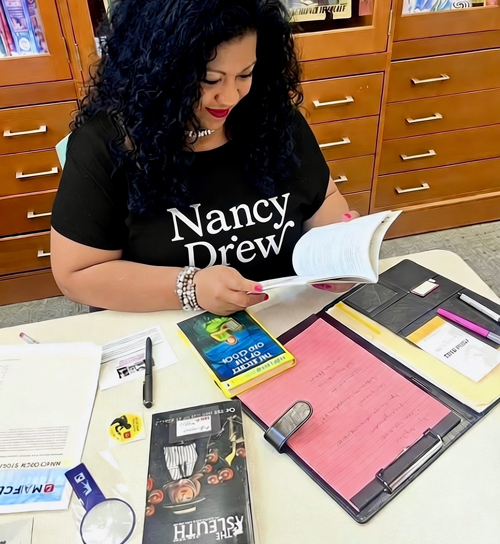
As a member of the press attending the 95th Anniversary Conference in Toledo, Ohio, the city where one of the most extensive private Nancy Drew collections now resides and where a majority of the original stories were written, I was honored to be a part of the celebration.
Across panels, rare archival displays, and conversations with devoted readers and collectors, the event unfolded as a fan gathering as well as a living case study in longevity. I put on my sleuth cap and dug deep to unpack the answer.
What does it take to build a story world with real staying power?
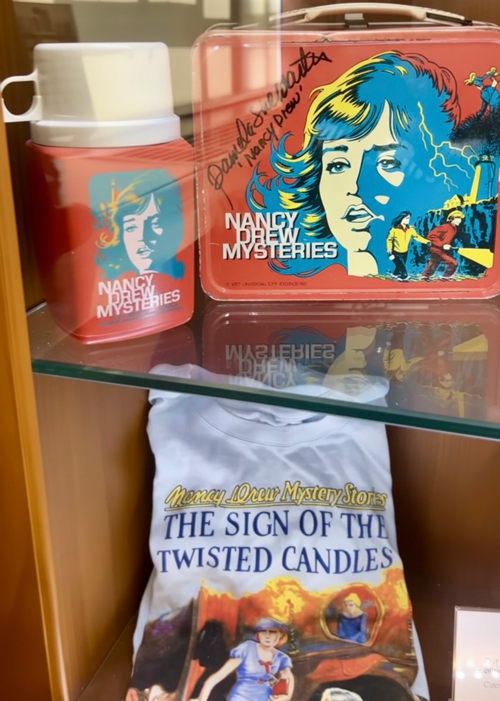
First-edition books, international editions, memorabilia, film screenings, and meticulously preserved artifacts offered a tangible timeline of Nancy Drew’s evolution as we gathered around over the course of three days, all of us in awe of the enduring relationship between a story and its audience.
Nancy Drew as a Blueprint Character
While plots are what get our attention and story worlds are what keep us returning, characters are what bind us to a story.
From her earliest appearances in 1930, Nancy was envisioned by Edward Stratemeyer and written by Carolyn Keene (née Mildred Wirt Benson) with a clarity of purpose that still resonates today.
Nancy Drew is a relentlessly self-directed driver at the center of every story, leading readers through the plots with qualities that readers trust. Curious. Capable. Never condescending.
Regularly credited with inspiring generations of readers—especially girls and the very author of this piece—to pursue careers in writing, journalism, law, and investigative careers, Nancy Drew has truly stood the test of time. But how?
1. Agency: A Character Who Moves the Story

For writers, as well as readers, this key literary distinction matters. As events unfold in the plot, Nancy is proactive and builds momentum. Each mystery unfolds because she chooses to investigate, to question, to push forward when others might stop, even if she is warned not to do so.
That sense of agency moves the story along and builds trust with the reader. Where Nancy goes, we are willing to follow, because we return to characters who act, decide, and shape their own outcomes. Nancy Drew has been doing exactly that for nearly a century.
2. Consistency + Flexibility (The Essential Balance)
At the same time, Nancy’s character has proven remarkably adaptable. Over decades, amid ghostwriters and evolving cultural expectations, and global translations, Nancy’s core identity has remained intact as a baseline, even as tone, setting, and supporting details have shifted.
That balance—between consistency and flexibility—is part of what allows a character to live beyond a single moment and across different audiences and formats. Whether younger treatments or older spins, readers inherently know who Nancy is. With that, it becomes a natural transition to accept seeing her in new contexts, new formats, and new generations of storytelling.
3. Repeatable Structure (Why Readers Come Back)
Each book offers a contained mystery, but the experience of reading one builds an expectation for the next. This fabric of familiarity is part of the appeal and is a quietly powerful structure.
For writers, this is where character and story world begin to intersect. Nancy Drew exists within a framework that invites repetition without fatigue as she solves mysteries. The result is a reading experience that simultaneously feels reliable and fresh, a combination that keeps audiences locked in.
4. The Key Element Re-Emphasized

All together, these elements form something close to a blueprint, though no one can truly predict the magic of a character’s connection with its readers or whether or not a core identity will be strong enough to remain recognizable over time. A narrative structure that supports continuation rather than conclusion is a dream establishment for many writers to work from, for mystery writers in particular, but it truly does start with character.
While it might seem anti-creative or somewhat contrived to plan one’s character in a highly strategic way, it is valuable for writers to take note that none of Nancy’s core characteristics were accidental. It was all well thought out and implemented under the direction of the Stratemeyer Syndicate before The Secret of the Old Clock’s debut in 1930, launching the series into the literary stratosphere.
Though Nancy Drew solves fictional mysteries, it is her character’s design—grounded and real—that has sustained her.
Story Worlds & Scalable IP
If character is the entry point, the story world is what makes longevity possible.
And in that respect, Nancy Drew offers one of the earliest—and most instructive—examples of what it looks like when a narrative expands beyond a single series into a fully realized, scalable framework of Intellectual Property.
1. From Series to System
Since her debut in 1930, Nancy Drew has grown far beyond her original run of mysteries.
What began as a tightly structured series, originally published by Grosset & Dunlap, evolved into a network of spin-offs and reinventions, and has continued under Simon & Schuster imprints since 1979. Consistently, Nancy Drew has managed to meet readers—both loyal and new—at different ages, with various interests, and during countless cultural moments.
From Nancy Drew Mystery Stories to The Nancy Drew Files, Nancy Drew Notebooks, On Campus, and later re-imaginings like Girl Detective and The Nancy Drew Diaries, the Nancy Drew character has been continuously reintroduced without losing her core identity.
The result is a long-running series rooted in a framework that allows expansion while remaining familiar to its devoted audience.

2. Built for Continuation
Though its enormous success could not have been predicted, the scalability of Nancy Drew’s narrative system didn’t happen by accident. It first required the vision of a foundation that could support repetition, variation, and growth.
Each new mystery offered a self-contained experience, but over time, it also consistently reinforced a larger, ongoing world for readers to re-enter at any point. For writers, this is where the idea of “story world” becomes practical and tangible.
Start with character, setting, and plot/premise, yes, but also—with intention—create a narrative environment flexible enough to sustain multiple entry points. Do this while still delivering a consistent emotional and thematic experience, and you are writing with continuity.
3. Human Core + Cultural Longevity = Global Reach
Over time, its deliberate structure has allowed Nancy Drew to travel far beyond her original audience. With translations in dozens of languages, her stories have reached readers across generations and across borders.
That international reach is both a byproduct of popularity and a reflection of how clearly the character and her world are defined. Curiosity, independence, and the pursuit of truth are core themes that translate regardless of race, ethnicity, or gender. And because they do, the story holds and organically expands. All writers should find inspiration in this.
4. Beyond the Page: Adaptation + Merchandising
Like many enduring literary properties, Nancy Drew’s presence extends beyond books. Film and television adaptations, video games, and a range of licensed merchandise such as clothing, toys, and even cereal boxes, have allowed the brand to remain visible even as formats and platforms evolve.
But what’s notable is the way each extension reinforces the original experience rather than replacing it. The core remains the same: a young detective, a compelling mystery, and a world built on discovery. Everything else grows from there and simply adds to it.

The Takeaway for Writers
For writers, the inspiration isn’t intended to be that every story needs to become a franchise of endless IP opportunities. Perhaps yours doesn’t need to be. Perhaps this isn’t a goal you’re intending.
The key takeaway is that sustainable stories and story worlds are built on a strong foundation that allows room to grow if the opportunity arises.
Nancy Drew began solely as an idea for a strong female character during a time in history when society needed a cultural shift for what a female character could be. The expansion across series, formats, and platforms wasn’t the original goal of the series. Who Nancy Drew was at her core was. It starts with that.
But perhaps the strongest measure of Nancy Drew’s staying power is in the community that has formed around her. At the center of that legacy are devoted readers like myself, and sustaining collectors like Jennifer Fisher, whose work ensures that Nancy’s story world and legacy are actively preserved and remembered.
Longevity, as the Nancy Drew 95th Anniversary Conference made clear, is championed by the community that loves it.
For more fantastic content, community, events, and other professional development opportunities, become a member today! Not sure if there is a chapter in your area? Check here.

Philana Marie Boles is the author of Little Divas, a middle grade novel, as well as the YA novel Glitz, and adult novels including In the Paint and Blame It on Eve. Her debut novel in verse, a YA mystery, will be released in October, 2025. An in-demand presenter and keynote speaker, she loves to motivate and inspire audiences from school age to adult. She lives and writes in Los Angeles, California.
Photographs by Philana Marie Boles


Pingback: The Case of Nancy Drew’s Most Devoted Sleuth: Jennifer Fisher and a Literary Legacy, a Q&A | Kite Tales
this is really fascinating. Because the Stratmeyer group also did the Tom Swift books and the Hardy boy books and none of them lasted in the way that Nancy Drew did. As a child I read all those series. Also the Dana girls which was a spinoff from TheNancy Drew idea
what’s interesting is she always remained the same. I don’t remember Nancy Drew ever growing as a human. I should probably read one of the latest ones.
LikeLiked by 1 person
LOVED, loved this article. I read all the Nancy Drew books as a teenager and this disection was interesting as well as instructional. I’m going to grab a copy of one of the older versions to read like a writer!
LikeLiked by 1 person