January is not just right around the corner—it’s tomorrow! But don’t panic. We still have time to make our resolutions or More/Less lists (see below and linked), and to dream big for 2026. Hopefully, revisiting some of the ideas and insights in Kite Tales’ 2025 posts through the quotes and article links below will provide a fresh sprinkle of information and inspiration to help you get started. Write on. Draw on. Read on!
Poetry invites experimentation. Many writers have accepted the invitation and found ways to uniquely express themselves—by diverging from traditional formats in ways that enhance the meaning and imagery of their poems. We’ll take a look at a few of these artists and excerpts from their work, with a particular eye for the verse they created for children.
E. E. Cummings (1894–1962) left a major mark on the genre of poetry. Poet-critic Randall Jarrell said of him, “No one else has ever made avant-garde, experimental poems so attractive to the general and the special reader.”1 Cummings rarely capitalized words (his name, included) and used space and punctuation in unusual ways, jarring readers from the expected and getting them to think about the words and their meanings in the context of the poems.
Longtime SCBWI member Joan Bransfield Graham is an award-winning children’s poet whose books include Splish Splash and Flicker Flash—shape poems about water and light (Houghton Mifflin Harcourt). Both books were School Library Journal Best Books of the Year and NCTE Notable Children’s Books in the Language Arts, among many other honors. Her other published works include The Song We Chose to Sing (ACTA), a poetry/music CD, and The Poem That Will Not End: Fun with Poetic Forms and Voices (Amazon Children’s Publishing/Two Lions). She has also contributed to many poetry anthologies.
Joan took a moment to answer some questions for the Kite Tales Blog.
ANN ROUSSEAU SMITH: Congratulations on your newest book, Awesome Earth, illustrated by Tania García. You have written many poems in many poetic forms. Why concrete or shape poems for this new book?
JOAN BRANSFIELD GRAHAM: Thank you, Ann! Since I was going to be featuring landforms, shapes that grace our Earth, what better way to explain a shape than with shape itself—concrete poetry. Not only is the poem talking about the landform but also showing it. Awesome Earth combines poetry, science, and art to explore what creates landforms from “Mountain,” “Glacier,” and “Volcano” to “Island,” “Hills,” and “Hoodoos”—artistic wonders that cover our Earth’s surface. It’s a perfect book for STEAM, National Poetry Month, and Earth Day. Many teachers have told me that my poetry has proven helpful for their students who are acquiring English as it offers many clues to unlocking the words.
ARS: I love how poems in any form—concrete or other—create visual images for the reader or listener. Can you share any writing tips for the poet in all of us?
JBG: MY FIVE FAVORITE POETRY WRITING TIPS
1. Use all of your senses.
2. Use vigorous verbs, marvelous metaphors.
3. Each poem is a mini-story with a beginning, a middle, and an end. If your poem doesn’t have a payoff or new perspective at the end, maybe it’s upside down. Don’t give it away at the start.
4. Use details to reach the universal. Zoom in for a close-up or write a wide-angle, big picture poem.
5. Write the poem you’ve never read before.
ARS: Since Awesome Earth is a nonfiction book it contains back matter, including information on landforms, a glossary, and additional resources for readers. How involved are you with the back matter? Do you find all the information and references, or does the publisher assist?
JBG: I did all of the back matter myself, including the photos. Originally, the additional information was going to be sidebars, but the design team decided to use everything as back matter. It’s a challenging endeavor to take a huge amount of research, distill it, and make it easy to understand. How do you introduce tectonic plate theory and continental drift to a four- to eight-year-old? My books always have a much wider age range than what is listed. In ice-skating, doing jumps and twirls can look so effortless because the skaters have put a lot of work into it. The same goes for writing. Speaking of age range, landforms are studied in all grades, just in different ways. Once a woman said to me, “I don’t know who is having more fun with this book (Flicker Flash)—my six-year-old grandson or his father, who is a physicist!” It’s wonderful to get a response like that!
ARS: You are a longtime member of the SCBWI and a volunteer board member of the Central-Coastal California (CenCal) Region. How helpful has your involvement with the organization been to your writing and publishing career?
JBG: When we first moved to California, I was at the local library one day reading a copy of The Writer magazine, where I saw an ad for the SCBW (it didn’t have the “I” yet) Summer Conference in Santa Monica. Where is Santa Monica? I thought it wasn’t too far away, decided to attend, and have been going ever since. I’ve made lifelong friends, heard amazing writers, artists, editors, and agents speak and share their knowledge of both craft and the business side of publishing, learned a great deal, and had an incredible opportunity to meet a wealth of creative, amazing people, and so I have been a volunteer forever—I am so grateful I joined! Thanks to you, Ann, for your volunteer work, for helping to share happy news and keep us all connected!
Thank you, Joan, for all your thoughtful responses!
For more information about Joan and her books visit her childrensauthorsnetwork! website. Join her on Facebook.
For information on SCBWI-CenCal events (open to all SCBWI members!), go to scbwi.org/regions/cencal.
For more fantastic content, community, events, and other professional development opportunities, become a member today! Not sure if there is a chapter in your area? Check here.
Images provided by Joan Bransfield Graham and the SCBWI Central-Coastal Region
I hope you all ended up on the nice list and took some time to rest and reflect before diving into goals for a new year. Have you made a list of resolutions?
I’ve always been quite a fan of lists. They hold so much promise. To-do lists, goal lists, recipe lists, gift lists, idea lists, bucket lists, reading lists—the list goes on. While I must admit that I’ve been known to transfer the unchecked items off any given list to its next incarnation (sometimes indefinitely), the simple practice of writing them can spark growth and creativity.
In the spirit of new ideas for the new year, here are four fun list-making exercises that may jump-start your creative streak in 2025:
It’s been a roller coaster of a year. But that means there’ve been ups as well as downs. Joy, growth, progress, breakthroughs, satisfaction. So, take a moment to peruse our traditional year-end inspirational quotes column, which this year includes a baker’s dozen. We need ’em! And we have them, thanks to all of you who have been kind enough to share your time, expertise, images, thoughts, words—and reasons for huzzahs—with all of us through Kite Tales. Now, let’s hop in the time machine together and take a look back at some of the highlights.
Marie Kondo has inspired millions of people to simplify and streamline their lives by assessing their belongings and keeping only what sparks joy in their life’s story. Are you ready to do the same for the stories you write?
by Cara J. Stevens
The author is downsizing while also welcoming a new book into her life.
I’m in the process of packing up our house for a move. We’re downsizing from a large cozy, suburban house to a sparkling new, small apartment in the city. We’re also becoming empty-nesters as our son is moving into his first apartment and our daughter is happily settled across the country. To prepare for this new chapter, I’ve been systematically going from room to room, sorting our belongings into piles: keep, donate, sell, send off with the kids, and throw out. What has helped me through this potentially overwhelming task is Marie Kondo’s transformational book, The Life-Changing Magic of Tidying Up: The Japanese Art of Decluttering and Organizing.
At the same time, I’ve been working with clients struggling to edit their picture book manuscripts. They’re having trouble “killing their darlings.” It hit me, as I was elbow-deep in memorabilia, that downsizing a home and downsizing a manuscript share striking similarities. Both require looking objectively and lovingly at what has brought you to this moment and assessing its usefulness for the journey ahead.
Poet, picture book writer, and verse novelist April Halprin Wayland
In her own words, April Halprin Wayland is “a writer, a mother, a wife, a speaker, a fiddle player, an organizer, a teacher, a poet, a doodler (see blog posts), a daughter, a sister, a performer, a storyteller, a peace activist, a traveler, a walker, a hiker, a meditator, an aqua farmer, a sun farmer, an animal lover, a cloud collector, a procrastinator, an infrequent twitterer, facebooker (sometimes) and instagramer. All!”
Paige Vinten Taylor: Welcome to Kite Tales, April. We’re so glad you’re here with us to talk everything poetry. Can we begin at the beginning? When did you first decide that you loved poetry?
By Jaime Zollars, Illustrator Coordinator, SCBWI CenCal
As the illustrator coordinator for the Central Coast, I’ve found that a topic of primary interest among member illustrators is agents, and the most pressing question is how to find one. If you are an illustrator seeking representation, my best advice is to consider whether or not you are ready, do your research, create an ordered list, reach out to artists represented by agents you plan to contact, double-check submissions criteria, solicit no more than a few agents at one time, and be prepared for another round of submissions if your first attempt is not what you hoped!
1. Is your work ready for an agent? You only have one chance for an agent to see your work for the first time. Consider whether your work is ready for an agent. Examine your work for consistency, craft, and presentation. Does your work have a developed look to it that has a unique identity? Does the work appear to be crafted professionally? Is the work available on a website that is carefully curated, easy to navigate, and professional? If you can say yes to all three questions, you may be ready to find your match.
Then you will likely wonder, “How do I find an agent?” This is the golden question, but there is a better question to ask.
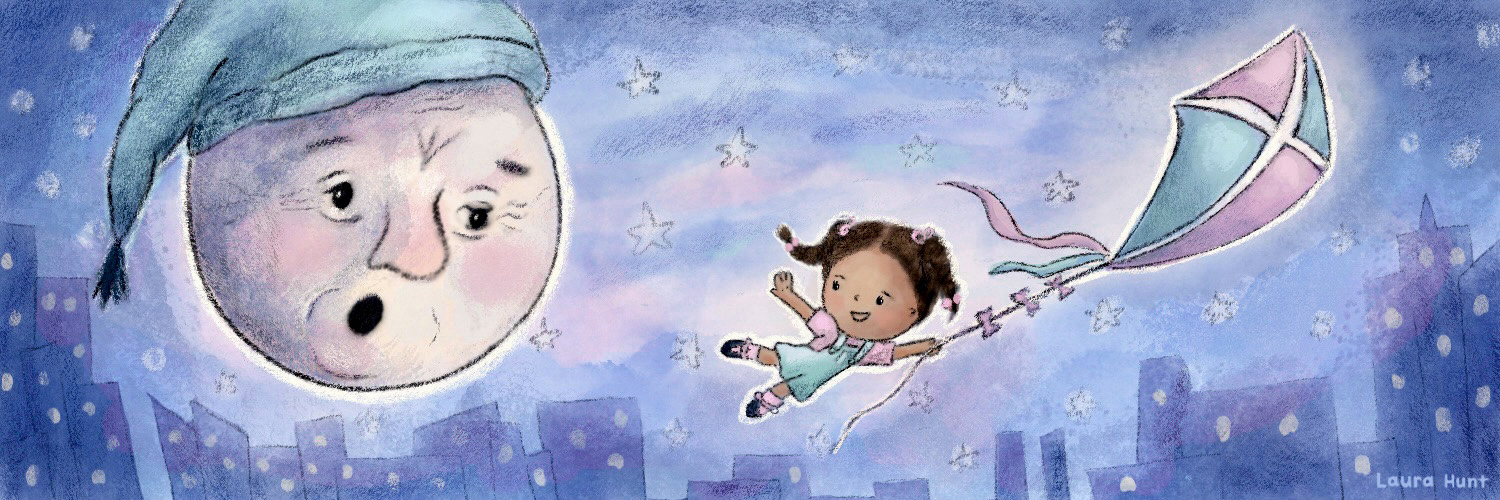
The high-flying little girl inLaura Hunt’s illustration “Kite Night,” winner of this year’s SCBWI-L.A. Twitter Banner Contest, answered the question of whether it’s ever too late to follow your dreams.
Editing Kite Tales has its perks. One is being among the first to see, hear, and be able to use the many uplifting ideas expressed by the blog’s kidlit guests during the year. Another is being one of the first to look back at year’s end and take inspiration anew. Here are some of my favorite 2023 moments gathered up in KT’s traditional list of 10 inspiring quotes. (Plus some extra inspo via the images.) Scroll through. Click through. Catch a thermal current and be uplifted. Thank you to everyone who brought words, pictures, and stories to the blog this year. Thank you to our readers! May you continue to soar in 2024.
“Ask an Editor” is a quarterly forum wherein SCBWI members submit questions that are answered as part of our Kite Tales blog.
Hi Christine—I’ve finished the first draft of my middle-grade mystery but still have a ways to go before it’s ready for me to submit it to literary agents. When do I start writing my query letter?—Ava,Los Angeles




 Kite Tales