
Tags
author, Ellen Hopkins, interview, Jim Averbeck, Laurent Linn, Nancy Paulsen, National Poetry Month, Philana Marie Boles, publishing, SCBWI community, verse novel
by Philana Marie Boles

Introduction
Ellen Hopkins is a New York Times best-selling and multi-award-winning author, a celebrated literary force whose courageous storytelling has enthralled readers like me for over two decades. She is perhaps best known for her raw and poignant novels written in verse. The real-life challenges of being a mother prompted the first of these, Crank, inspired by her now-recovered daughter’s struggles with an addiction to crystal methamphetamine and a consequent stint in prison.
Following the success of Crank, Hopkins has gone on to author more than a dozen acclaimed novels in unabashed verse. She has tackled subjects ranging from drugs to mental health to abuse to sex trafficking, and most recently, the foster care system in her new novel, Sync.
In a transparent conversation with me for Kite Tales, Hopkins reflected on her writing journey from launching her career without an agent to becoming a nationally celebrated author. She shared generous insight about her creative process and compelling words on why verse remains a vital form of storytelling. With her timely advice to SCBWI writers navigating the uncertainties of today’s publishing landscape and today’s world, period, it is an honor to share this interview with Ellen Hopkins.
From the moment Ellen said “hi,” I felt less like an excited fan and more like I was just having a conversation with a friend who truly cares about her writing peers…
The Beginning
Philana Marie Boles: Ok, you’ve had one of the most prolific and inspiring writing careers with such incredible publications, stories that haunt the reader’s soul after reading. Tell me how it all started for you. When and why did you start writing? What was your inspiration?

Ellen Hopkins: I actually started writing as soon as I figured out how to do it (laughs). I was one of those geeky kids who enjoyed writing book reports. My mom loved books—classic literature especially—and had me reading chapter books before kindergarten. I was an early, avid reader. And, as we know, avid readers often become writers. Eventually, I remember, I started thinking, I want to see a book I’ve never seen before.
PMB: That tried-and-true adage, write what you want to read. I love it. When did you first see your name in print?
EH: I was nine. I published a haiku in the local newspaper. It was small, but it said “by Ellen Wagner.” And that was it, that did it. I was a published author. And I knew that’s what I wanted to be forever.
PMB: As someone who truly loves your work, I speak on behalf of many fans when I say we are so glad you made that decision. And yet, you didn’t focus on poetry, professionally, at first? Correct?
EH: Correct. I took a giant detour in my 20s. I studied journalism in college, but I dropped out when I married “Mr. Wrong.” I had kids young, and I ran a couple of businesses. After catering, I started a video rental store. All those years, while I was raising my kids, I was writing. I wasn’t really trying to publish, but I accumulated drawers of yellow legal pads with poems and short stories. And I didn’t know what to do with any of it.
Actually, it wasn’t until I found SCBWI that I started on my path to publishing. I was raising kids, and sort of organically started thinking about writing books for kids.
When I met my current husband, John, “Mr. Right,” we moved to Tahoe. I had sold my businesses, and he asked me, “What are you going to do now?” I said, “I’m a writer.”
PMB: Wow. Pivotal.
EH: Oh, yes. Like most people who come to SCBWI, I thought I was going to write picture books, but I knew that wasn’t my skill set. I could probably write a decent one now, but back then it just wasn’t my natural focus.
Finding Her Voice in Verse
EH: Like a lot of writers, I had to find my way to my niche. I ended up writing nonfiction first. I did a lot of freelance journalism and published 20 nonfiction books for kids before I ever touched fiction.
PMB: And when you did, wow. Did you initially write Crank in verse?
EH: Well, I’d always written poetry and at the time, I was in a poetry group in Carson City. When I started Crank, I initially tried prose, but it just wasn’t working. Then I tried verse—and it clicked. I knew. This is where I belong.
PMB: It’s such a captivating story. I remember inhaling it. It breaks the reader’s heart in such complicated ways. It’s unshakable, the memory of reading it. Why the topic?
EH: Crank is based on my daughter’s actual struggle with addiction. I knew I had to be honest about how my daughter took the wrong turn. In her senior year all of her dreams disappeared for basically 25 years. She’s doing well now. But I knew I wanted my novel to help teens avoid that mistake. I also knew many teens—especially reluctant readers—wouldn’t willingly pick up a 400-page book.
I attended a workshop with Sonya Sones, who’d written her debut novel in verse, and it helped me to realize how much verse immerses the reader into a character’s head. It’s so personal. It’s so immediate. It was the right form for what I needed to accomplish with Crank.
A Fateful Career Turn, Catapulted by Hard Work
PMB: Amazing. Ok, so how did Crank find its way to publication?
EH: I sat down for a manuscript critique at a writer’s conference with an editor from Simon & Schuster. I showed her a picture book manuscript first. She said, “This is beautiful, but I don’t do picture books. What else do you have?” I had ten pages of Crank. She said, “Send it to me when it’s done.” Not to romanticize what happened next, but it is what happened.
Three months later, I had 75 pages written. Without an agent, I asked her if she’d like an exclusive look. She said yes. She read it and offered me a contract to finish the book. Again, no agent. First novel. Not even finished. That doesn’t happen anymore in publishing, but it happened.
PMB: So true. That’s amazing.
EH: There’s a formula: Talent + Perseverance + Luck. But you can also create your own luck. I’d helped organize the writer’s conference where we met [not SCBWI] and I had invited her to host manuscript critiques to increase the amount of money we could pay her for coming.
Unintentionally, she and I built a relationship from that.
PMB: It was meant to be. So, once you had the contract, how long did it take to write Crank?
EH: A little over a year. I was still freelancing and writing nonfiction at the time.
PMB: And since then—you’ve written over a dozen novels?
EH: Fourteen with Simon & Schuster. More recently, I’ve written middle grade novels with Nancy Paulsen Books at Penguin. I’m finishing another one now.
PMB: You also changed agents recently, correct?
EH: Yes. I did end up getting an agent eventually. I was with Laura Rennert for many years. During COVID, I sensed my career had slowed and told her, “If you want to part ways, I understand.” I didn’t expect her to say yes—but she did. It was amicable.
I had an interim agent who was a poor fit—unresponsive and slow—and I’ve just signed with Jim Averbeck at East West Literary. He’s smart, editorially strong, which I really wanted, and someone I trust.
PMB: Interesting. What’s the value of an editorial agent?
EH: If it’s something you want or need as a writer, they give you a layer of editorial insight before submission. They catch weaknesses and help shape the project, and it becomes a true partnership where trust is essential.
PMB: Very true. Besides your agent, before submissions, do you still workshop your work with writer’s groups or share it with beta readers?
EH: Not really. I don’t even show my husband anymore (laughs). I’m also no longer writing on spec; I’m writing on proposal. But I do have people I know I can trust if I do need another set of eyes.
And Now, Sync
PMB: Now let’s talk about Sync. A YA novel about twins separated in the foster care system and by the different paths their lives take—what a gripping plot! Poetically powerful and yet emotionally delicate, it deals with the emotional terrains of the foster care world in ways that I’ve never experienced as a reader. Congratulations on another wonderful novel in verse. From the dedication page, it grabbed me. “This book is dedicated to all those struggling to experience the joy and comfort of home. My wish for you is safety, shelter, belonging, and love.” Just wow.

EH: Yeah. Over the years, I’ve worked with a lot of kids, not just through school visits. I was invited to work with foster kids. I had a nonprofit for a while that helped kids get off of living on the streets and into safe housing and into college or trade school… A lot of them were aged-out foster kids. So I really understand that world.
PMB: There are good people in the system, but also really bad ones. There are good things about a kid having a foster home to begin with, too, and also sometimes deeply complicated, heavy problems from doing so. Sync remarkably shows both sides of that.
EH: Thank you. The thing is, I’ve also worked with kids in lockup—juvenile justice system. Again, same thing—there are really good people and really not-so-good people there too.
PMB: I am curious—how much of what happens in Sync is drawn from your own experience? Did you go through foster care yourself? It’s incredibly well depicted.
EH: No, I wasn’t in foster care. I was adopted as a baby. But, from the other perspective, I’ve raised kids who weren’t biologically mine. I’ve worked closely with a lot of foster youth.
PMB: Got it. So, your inspiration for Sync came more from working with foster kids?
EH: Absolutely. For example, there’s a part in the book where Lake and Parker are living in a car. One of the girls I worked with—she lived in a car with her mom for six months after being kicked out by her dad. So, I chose to imagine what that was like, to live in a car. That kind of real-life detail is what matters.
PMB: And the twins—was that just creative license, or based on anyone?
EH: Twins seem to be a recurring thing for me. Maybe I was detached from one in the womb or something! (laughs) I’ve written twins before. I just find the bond between twins to be so interesting—surviving that tiny space together. The emotional connection is fascinating to explore.
PMB: Very fascinating. Sync has gotten incredible reviews—people say it’s powerful and captivating, and I agree. But Kirkus used a word that best stood out to me. They said Sync is “necessary.” In your words, why do you think Sync is a necessary story?
EH: Thank you so much. Well, to that, about it being necessary, I say that I just think there are segments of society that are viewed as lesser, foster kids being one of them. People see them as broken, as bad, and they’re not. And that needs to change. That is why it’s necessary. All kids are the same inside, and the world needs that reminder, especially now. Everyone’s so pissed off at each other—the left, the right—and we’re all forgetting how much we all have in common. If we can get back into that space, maybe then we’ll survive as a species.
PMB: Powerful words. Could not agree more, Ellen. And that makes you, too, very necessary. Having said all of that, I cannot commend you enough on Sync. It is a completely satisfying read, no doubt, and yet so many of us who have read it just want more of this captivating world. Will you grant us any more to this world? Will there perhaps be a sequel for what remains unsaid?
EH: (laughs) Everyone keeps asking me that. I don’t know if it necessarily demands a sequel, but I’m serializing a novel on Substack that Simon & Schuster passed on. After that, I’m going to write short stories or novellas about characters from previous books for my Substack. So, maybe if I don’t write a full sequel to Sync, there may be a “P.S. chapter” just to give readers some more closure.
Advice for Writers—Especially in Verse
PMB: That is exciting and hopeful news. Now, for the writers who are reading this, what writing advice do you want to share, especially for those writing in verse?
EH: For all writers, write the story that speaks to your heart. Also, don’t censor yourself mid-process. You can go back and edit later.
Start with character. Know your characters deeply—their families, their fears, their past—and let plot flow from who they are.
For verse writers, remember, a verse novel isn’t just a string of poems. A novel in verse needs to have a plot and dialogue. The power of a novel in verse is in what you leave out. Also, read your work aloud—there should be rhythm and musicality to verse. Kids respond to that. All readers do.
Also, use sensory detail in fresh ways. What does fear smell like? What does anger taste like?
PMB: Insightful words. Do you think there’s room for more novels in verse?
EH: Absolutely. Ten years ago, editors said, “We already have a verse novelist.” Now? Kids crave it. Don’t just do it because it’s popular. Study the craft. Read modern poetry. Read Elizabeth Acevedo. Read Jason Reynolds. Read prose writers like Jandy Nelson, whose language feels like poetry.

PMB: Awesome. It’s great to have those specific recommendations. Before we go, do you have a final message for the SCBWI community, specifically, since this is a community that you are also a part of?
EH: Support librarians and teachers. They’re under fire—and they’re trying to get the right books to the right kids. Even if a book doesn’t speak to you, it may save someone else’s life. Also, keep hard copies of books. Digital media can be erased. Printed words last.
PMB: I have no doubt our readers will print and cherish this article for that reason. On behalf of Kite Tales, we all thank you, Ellen.
For more fantastic content, community, events, and other professional development opportunities, become a member today! Not sure if there is a chapter in your area? Check here.

Philana Marie Boles is the author of Little Divas, a middle grade novel, as well as the YA novel Glitz, and adult novels including In the Paint and Blame It on Eve. Her debut novel in verse, a YA mystery, will be released in October, 2025. An in-demand presenter and keynote speaker, she loves to motivate and inspire audiences from school age to adult. She lives and writes in Los Angeles, California.
This interview has been edited for length and clarity.
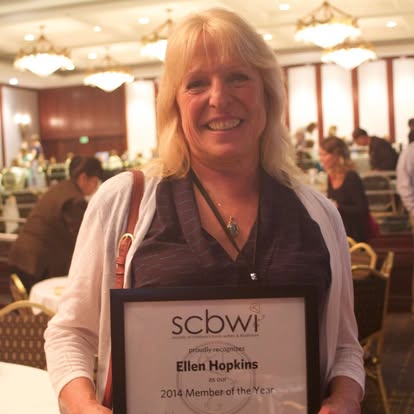
Photos courtesy of Ellen Hopkins
 Kite Tales
Pingback: 10 Inspiring Kite Tales Quotes from 2025 | Kite Tales
Pingback: Ellen Hopkins (SCBWI Kite Tales Interview Edition) | PB Rippey Writes
I so appreciate this piece. Gave me so much to read and research–but of course, because: Ellen Hopkins.
LikeLiked by 1 person