
Tags
authors, craft, digital, illustrator tips, illustrators, improv, Laura Hunt, process, SCBWI community, SCBWI members, sketch comedy, watercolor, writers

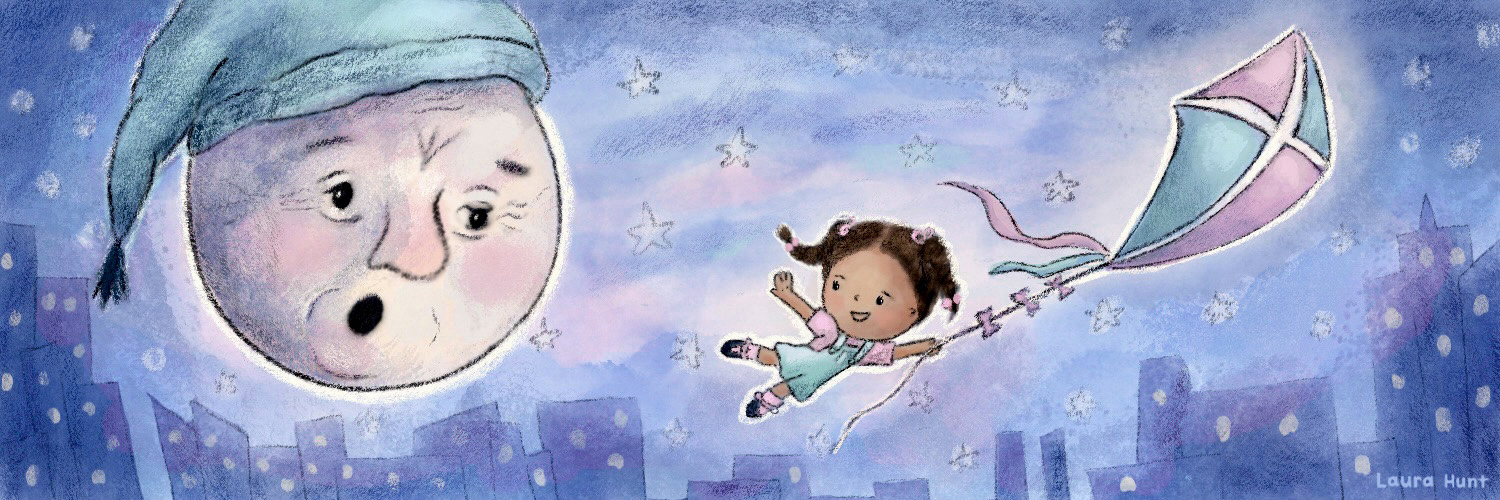
In SCBWI-L.A.’s latest Twitter Banner Contest, illustrators were asked to submit their most creative response to our prompt: KITE NIGHT. The winning contestant’s artwork is featured on the Los Angeles Region SCBWI Twitter profile until the next contest, with a feature article published here on Kite Tales.
We’re excited to announce Laura Hunt as our winner! Laura is an author-illustrator who grew up in Connecticut and now resides in Los Angeles with her college sweetheart, young son, and old Yorkie. Her dummy received an honorable mention from PB Party 2023. Her comedy writing background includes writing sketches on a house team for the Upright Citizens Brigade, and her work has been featured on Funny or Die and HuffPost.
Read on to learn more about Laura, her tools and tips, and what inspires her work.
Kite Tales: How did you come up with your design for the contest?
Laura Hunt: There’s something mysterious and magical about the night sky, and some of my favorite memories from childhood include gazing at beautiful illustrations of the man in the moon. So, when I read the prompt, I automatically pictured the man in the moon with a little girl flying past him on a kite. As I was sketching, the story began to evolve. One thing I learned from improv classes is to keep asking the question “if this is true, what else is true?” So, if this little girl is flying past the moon, what else is true? The moon probably doesn’t see this every day, so it’s probably true that the moon is surprised and maybe even concerned! While making the moon’s facial expression, I felt it would add an extra dimension for the moon to be sleepy, as if the little girl woke him as she flew by.
KT: You have a background in fine art and comedy writing, how did you get into children’s book illustration? How has that background affected your work?
LH: I was doing landscape and figurative paintings but decided to experiment with creating watercolor paintings as nursery decor. Dipping my toes (and paint brush) into nursery art is what made me realize how much I loved the world of children’s illustration. It felt like the truest expression of how I see the world, or at least how I want to see the world. As a child, I would write and illustrate my own picture books, and even though as an adult I always felt a tug to continue doing so, I never felt like I could develop the skill level necessary for such a challenging and gorgeous art form. But I was hooked and began drawing more and more illustrations, took illustration classes, and found lots of encouragement from working illustrators who assured me that it wasn’t too late to follow this dream.

As I started to write stories to illustrate, I drew upon my comedy writing background and approached the manuscript as if I were writing for actors on stage. This helped me think visually and focus on the action and dialogue, since in sketch comedy, you have to “create a spectacle.” I often refer to my notes from sketch and improv classes when working on my manuscript. When I begin working on the dummy, I use my sketch video background to think about the composition like “camera angles.” Since I would plan out each shot for my comedy videos, this feels exactly the same. When I realize that I’m laughing while drawing, that’s when I know I’m going in the right direction!
KT: Tell us about your work—your goals as well as favorite materials and techniques and how you use them.
LH: I am in the process of completing my second picture book dummy, which is part of a series. My first dummy took me a year to complete, but my second dummy has been way faster because I learned so much from the first. I love using the resources from Debbie Ohi, which you can print at Templates For Book Creators – Debbie Ridpath Ohi at her website. Her templates help you brainstorm six different approaches to sketching one scene. This discipline encouraged me to come up with far more creative layouts and ways of telling the story than if I had bypassed this process. Since the sketch area on the templates is intentionally small, it forces me to stay very general and not get caught up in too many details. I work with a pencil and paper for this part of the process.

Next, I pick my favorites from each brainstorm and sketch them on index cards, which I then tape to the wall by my desk so I can see how the pages flow visually. For me, this brainstorming step of the process is the most tedious and challenging part, but also the most exciting. After I feel satisfied with the index card choices, I begin sketching each spread on Procreate, and I bring those sketches to my critique groups for feedback. I love getting feedback; it has been the most important part of my process, and given that I always need to make changes, working digitally is a bonus!
My current goals are to complete three picture book dummies that I feel excited to share and to begin querying agents. I hope to have my work published as an author-illustrator, and I would also love to illustrate for other authors.
KT: What does your practice look like? (E.g., Is it a daily practice, do you keep a sketchbook, do you work on multiple projects—and multiple types of projects—at the same time? How much traditional and how much digital?)

LH: I used to illustrate with ink and watercolor, but now I work digitally. I find that digital painting is more accessible for me, especially with a young child. I can squeeze in drawing at random times throughout the day without having to set up and clean up. I can also work in the waiting room at the doctor’s office or even when I’m sick in bed! I also feel freer to experiment since I can save multiple versions easily, and I know I’m not “wasting” precious watercolor paper.
I tend to get really focused on one project at a time, especially when I’m working on a dummy. But I do need to take a break from the dummy now and then to do an illustration in full color, just for fun! That’s why I love doing prompts such as the wonderful one you hosted.

The most important part of my practice is my critique groups. I meet weekly with two different groups whose members I met through SCBWI, and I have learned so much from these knowledgeable and supportive women. It brings me so much joy to see their faces every week and to share in this journey together. My life has been truly enriched because of this kidlit world, and I am grateful to SCBWI for fostering it.
KT: Where do you go for inspiration?

LH: My five-year-old son is my greatest inspiration. I am always jotting down notes about the things he’s interested in or struggling with. I also find visual inspiration in animated movies and other picture books. I study how my favorite author-illustrators use negative space and the creative ways they lay out the story. On Instagram, I study my favorite illustrators’ work and how they use color. I also find that reading novels helps to nurture my storytelling skills. And some of my story ideas come first from an illustration. I’ll doodle something I think could be fun, and as I sketch it, it starts to become more of a story, which can sometimes lead to a book idea!
KT: Can you give our readers their own illustration prompt?
LH: I have never given a prompt before! How exciting! Well, since my son loves clotheslines, and I love woodland scenes, the prompt I will offer is: “woodland clothesline.”


KT: Thank you so much, Laura. Readers, to see more of Laura’s art-related content and new work, follow her on Instagram at @LauraHuntStudio. For original fine art and illustrations, visit her on Etsy. Share your response to Laura’s Kite Tales illo prompt with your comments below, and by tagging your images on social media with #KTIllo.
For more fantastic content, community, events, and other professional development opportunities, become a member today! Not sure if there is a chapter in your area? Check here.
Images provided by Laura Hunt.
 Kite Tales
Thank you for this interview! Laura Hunt’s work is wonderful and I look forward to seeing it out in the world.
LikeLiked by 2 people