
Tags
Chronicle Books, Katherine Roy, Melissa Manlove, nonfiction, prompt, Roaring Brook / David Macaulay Studio, submissions, writing exercise
 Just in time to help power your new year’s writing resolution, we’re introducing the Kite Tales Writing Prompt: #KTWriteOn. Each quarter, we’ll feature a writing challenge crafted by a kid-lit publishing professional. To kick things off, here’s a writing prompt created by Chronicle Books Senior Editor Melissa Manlove. As a bonus, Melissa is inviting submissions related to this exercise. Read on for details.
By Melissa Manlove
This writing prompt is for storytellers. Even those of you not interested in nonfiction—keep reading! We need you!¹
Children’s narrative nonfiction is a big growth area, but a LOT of the growth is clustered in the biography section. That’s a great thing for that section—but it means there is a vast area of opportunity in the rest of nonfiction, especially science.
 I don’t mean there aren’t some AMAZING narrative nonfiction books being published in the science section. There are. But there could be a LOT more. The money is, figuratively, sitting on my desk. Come and get it!
There are plenty of different ways to approach nonfiction in a way that gives it voice and personality and life². This prompt is specifically for people who care about narrative arc. Narrative arc is built on change in emotional state over the course of the book. It’s (relatively) easy to see how you could describe the changes in a historical figure’s emotional state over the course of their life, and I think that’s why the storytellers who are venturing into nonfiction are gravitating toward biography.
But when your subject is not a person… sharks, for instance… you have to think about the change in emotional state you want for your reader. Let’s take as an example the terrific Neighborhood Sharks by Katherine Roy (Roaring Brook / David Macaulay Studio). Her book does this beautiful job of starting in the same emotional place most people start: sharks are SCARY. From there, it leads us into the many cool details of sharks and lures us to a next emotional state: sharks are FASCINATING. And once it has us there, it hooks us with sharks are VULNERABLE. These powerful, terrifying predators? They’re endangered. We humans have the power to kill them. Or… we can save them.
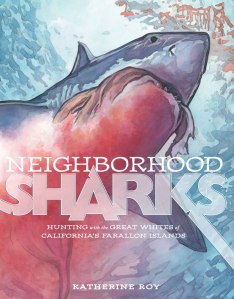 Just like that, we move from FEAR to FASCINATION to SYMPATHY. And we learned a bunch about sharks!
Now you: Choose one of the below.
- Choose a science/other nonfiction topic that you DON’T know much about, but about which you have some strong feeling, and research it until the way you feel about it changes. Put that emotional journey on the page so that readers feel it, too.
- Choose a science/other nonfiction topic that you DO know about, but about which you have a strong feeling that is very different from the feeling you had before you knew about the topic. Put that emotional journey on the page so that readers feel it, too.
The world is a fascinating, exciting, scary, moving, beautiful place, and we do both kids and books a disservice when we describe the world in ways that ignore the emotional power of the world and each reader’s personal power to care.
¹ I mean, those of you not interested in research… well, this isn’t going to work for you. Thoughtful, thorough research is KEY in nonfiction.
² And I want ALL of those ways, so if you have an idea for an approach that doesn’t match this prompt, SEND IT TO CHRONICLE ANYWAY³.
³ Read and follow our children’s submission guidelines, please!
To share the topic you’ll be researching and/or the one-sentence emotional arc you surrounding it: Comment on this blog post or Tweet us @SCBWISOCALLA with the hashtag #KTWriteOn.
Follow Melissa on Twitter: @mmanlove
For more fantastic content, community, events, and other professional development opportunities, become a member of the Society of Children’s Book Writers & Illustrators today! Not sure if there is a chapter in your area? Check here.
Images by Dustin Lee on Unsplash, Melissa Manlove, and Roaring Brook / David Macaulay Studio.


Pingback: #KTWriteOn with Agent Clelia Gore: Unsung animal heroes | Kite Tales
Pingback: #KTWriteOn with Agent Bridget Smith: Query Letters When You Have No Idea Where To Start | Kite Tales
Pingback: #KTWriteOn with Author Marilyn Cram Donahue: Character, Voice | Kite Tales
Hi Dianne, I didn’t see a word count in the guidelines but I think it would depend on a few variables. If you find out let me know too. Thanks!
LikeLiked by 2 people
Yes, dittos for me Venessa. I expected word counts they’d prefer in the writer’s guidelines but that infor is not there. I think the next best thing to do is to check out books in this same line that they have published and either count or estimate the words. (I estimate by counting several average pages, average that number, then multiply by the number of pages.) Just need time to do that research… Thanks for responding.
LikeLike
How many words should be in a nonfiction children’s book like this? I can’t see it in the writer’s guidelines. Thanks.
LikeLike
Hi Dianne! If you are an SCBWI member, you can find this information and more in THE BOOK, available on the SCBWI website if you’re logged in to your account. Google is also your friend for this question. Non-fiction children’s books vary in length depending on age range (picture book, middle grade, YA) and subject matter (topic, illustrated or not, etc). Look for books whose stats match what you’re hoping to write and use that as a guideline.
LikeLiked by 2 people
Also note: when Chronicle’s submission guidelines mention sending them the complete MS for younger children’s books, they are referring to picture books, which are often quite short. Anything that comes in chapters or should follow the guidelines for “older” children, even if it’s a chapter book meant for younger kids.
LikeLiked by 1 person
I’m not an SCBWI member … yet. (Life is just too busy at this point to add another thing I can’t take good advantage of.) I was hoping to send a pitch for the type of book Melissa Manlove is looking for here. I will look at the Sharks book. Thanks for answering!
LikeLiked by 1 person
I also appreciate the tip for the “older” children and books in chapters. I appreciate your responses. Thanks.
LikeLike
Thank you Erlina and Melissa for this fun opportunity!
An amazing nonfiction/science topic that interest me (very much) is the plight of our honeybees. When I learned that Harvard’s Microrobotics lab is developing a robotic bee or RoboBee to help with the worldwide scourge of Colony Collapse Disorder, I was intrigued! And so an emotional arc to this sciency topic would be: Honeybees are Important to our Ecosystem. Honeybees are Dying. RoboBees are Swooping In. To tie it all together: How can robotics help the honeybees?
I love this topic! To see my nonfiction proposal for this STEM book idea, please email me at: Venessa.Schwarz@gmail.com
Best to all who are working on a new narrative nonfiction idea! : )
LikeLiked by 2 people
Vanessa, this is a great idea! If you want to pitch it to Melissa and Chronicle, there is a link to their submission guidelines in the blog post.
LikeLiked by 1 person
Thanks so much, Sarah! I was just checking that out. I’ll send a pitch over. 🙂
LikeLike
Slugs and Slime gross me out. What’s with that slime? Discovering the purpose of slime and the creepy creatures that secrete.
LikeLiked by 2 people
Pingback: Opportunity for NF Writers | Blogzone
Thank you for this article on the emotional resonance in narrative nonfiction.
The human tongue fascinates me, especially her role in language development. Here’s my one sentence pitch; the title is a play on words:
ROLL OF THE TONGUE: A hidden, yet vocal organ shares her backstory of the exercise regime — the rolls, curls, and palate touches — and teamwork required to save her human.
LikeLiked by 2 people
What a great article. Thanks, Melissa.
About 250 years ago, the town I live in was moved two miles and no one knows why. It’s driving the folks at the historical society crazy. The problem is, in that day they only wrote down what was new, if everyone knew it there was no need to record it. That’s why there is documentation that Mr. Lancaster had the second horse in town, but there is no record of who had the first.
Anyone who lived then would be a ghost now, but what a backstory. And it’s that backstory that I’m creating. It’s all based on actual events in the area.
LikeLiked by 2 people
I loved this article, Melissa. You made nonfiction so much less intimidating to many, now that you explained the narrative arc it can take. As a former school teacher, I’ve always enjoyed bringing out a story with an emotional journey, no matter how rocket-science-ish they might be.
Every now and then, I’m surprised with new knowledge that plays a role in changing my beliefs. Fear switches to wonder.
I have started creating something which I hope to share soon.
LikeLiked by 2 people
Littering – Litterbugs discover where litter goes, how long it stays, and the damage it does. Now reformed litterbugs wear litter gloves to keep the earth clean.
Ed the Hermit Crab – Ed protects his home from conch shell hunters but when he begins to out grow it, he learns the reason why….and how to conga conch.
-Vicki
LikeLiked by 3 people
This is such a great exercise! I read books to kids at the library and they love to learn from non-fiction books, but so many of the books are sterile and don’t hold the kids’ attention to the end. Most of the time I find myself summarizing the information via the pictures so I don’t lose them. If more non-fiction books kept the “reader’s arc” in mind like Melissa suggests, I guarantee the kids would be more engaged. Those are exactly the types of non-fiction they stick with when we’re reading.
LikeLiked by 2 people